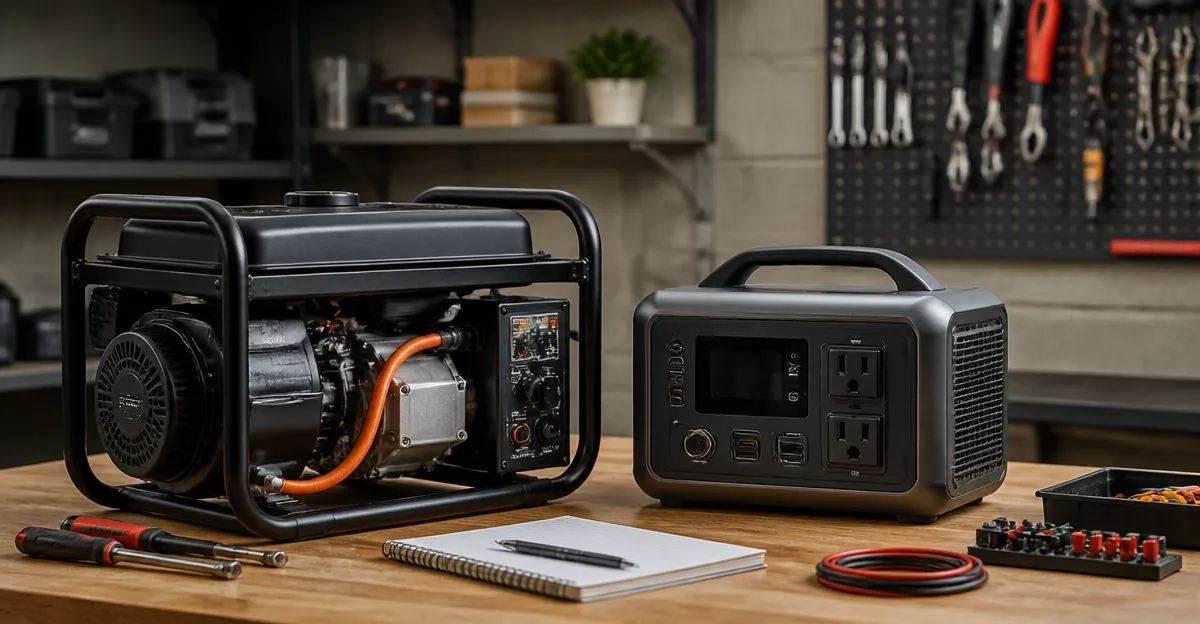
How to Build a Silent Hybrid Generator & Portable Power Station for Stealth Camping — DIY Quiet Off‑Grid Power with Solar, Battery & Inverter
Introduction
This guide explains how to assemble a low‑noise hybrid power solution that can sustain a campsite for days without drawing attention. One will learn to combine solar input, high‑capacity LiFePO4 batteries, and a quiet dual‑fuel inverter generator into a single, portable system. The result is a reliable, silent power source that supports lighting, communication devices, a small refrigerator, and occasional high‑draw appliances while remaining lightweight enough for backpacking.
What You'll Need
- High‑capacity lithium‑iron‑phosphate battery station (see step 2)
- Compact solar panel or portable solar kit (compatible with the battery station)
- Quiet dual‑fuel inverter generator for backup (see step 4)
- Heavy‑duty power cables, connectors, and a portable power strip
- Basic hand tools: wrench, screwdriver, wire cutters, multimeter
- Protective gear: gloves, safety glasses
Step 1: Assess Power Requirements
Begin by listing every device that will run at the campsite. Typical stealth‑camping loads include:
- LED lighting – 10 W total
- Phone/Tablet chargers – 15 W
- Portable fridge or cooler – 80 W
- Small fan – 55 W
- Radio or satellite communicator – 20 W
Add a safety margin of 20 % to cover start‑up surges. In this example the total continuous load is roughly 180 W, which translates to about 4.3 kWh for a 24‑hour period. Knowing this figure guides the selection of battery capacity and generator size.
Step 2: Choose a Battery Storage Unit
For silent, emission‑free power, a lithium battery station is essential. The BLUETTI AC180 provides 1152 Wh of usable energy, 1800 W continuous output (2700 W peak), and eight AC/DC outlets. Its LiFePO4 chemistry offers over 4,000 cycles and a 10‑year lifespan, making it ideal for repeated camping trips.
Key specifications:
- Price: $449.00
- Rating: 4.5/5 from 2,812 reviews
- Fast AC charge: 1 hour to 80 % at 1440 W
- Solar fast charge: 500 W input, 2.8‑3.3 hours
- Built‑in UPS: 20 ms switchover for critical devices
The AC180’s built‑in display and Bluetooth app allow real‑time monitoring of input and output power, which is invaluable when balancing solar input against load.
Step 3: Integrate Solar Charging
Pair the battery with a portable solar panel rated at 200‑250 W. Connect the panel to the AC180 using the included solar cable. Because the AC180 can accept up to 500 W, a single 200 W panel will replenish roughly 15 Ah per hour under optimal sunlight. During a typical summer day, this yields about 1.2 kWh of charge, enough to offset most nighttime consumption.
To maximize solar efficiency:
- Position the panel perpendicular to the sun’s rays (approximately 90° angle).
- Use a sun‑tracking mount if possible.
- Keep the panel clean of dust and debris.
Monitor the charge rate via the BLUETTI app; the unit will automatically reduce input when the battery approaches full charge, protecting the cells.
Step 4: Add a Quiet Dual‑Fuel Inverter Generator for Backup
Solar and battery power are silent but limited by weather. A compact generator provides on‑demand power when clouds persist or when a high‑draw appliance (e.g., a space heater) is needed. The WEN Dual Fuel Inverter Generator delivers 4800 W surge and 4000 W rated power, operates at only 62 dB, and runs on either gasoline or propane.
Key specifications:
- Price: $647.00
- Rating: 4.5/5 from 301 reviews
- Dual‑fuel capability for flexibility
- CO Watchdog sensor for safety
- Fuel shut‑off to prevent carburetor gumming
- Four 120 V outlets, 12 V DC, and USB ports
Because the generator produces a clean sine wave (<1.2 % total harmonic distortion), it can safely charge the AC180 or the BLUETTI Elite 100 V2 without damaging sensitive electronics.
When using the generator:
- Start on propane for lower emissions and quieter operation.
- Engage the eco‑mode switch to reduce fuel consumption at low loads.
- Run the generator for at least 10 minutes before connecting to the battery to stabilize voltage.
Step 5: Incorporate a Secondary Portable Power Station for Redundancy
While the AC180 covers most daily needs, having a second, lighter station adds flexibility for short trips or as a dedicated charger for high‑draw tools. The BLUETTI Elite 100 V2 offers 1024 Wh capacity, 1800 W continuous output, and a 45‑minute rapid charge to 80 % using 1200 W TurboBoost AC.
Key specifications:
- Price: $499.00
- Rating: 4.5/5 from 1,831 reviews
- 35 % smaller and 30 % lighter than comparable units (25 lb, 17 L)
- 11 ports including two 100 W USB‑C, two 12 W USB‑A, and dual AC outlets
- 10 ms UPS switchover for seamless router protection
- Whisper‑quiet mode at 30 dB
Use the Elite 100 V2 as a “front‑line” power source for low‑weight gear, while the AC180 remains the primary storage for heavier loads. Both units can be charged simultaneously from the generator or from solar panels, creating a flexible energy hub.
Step 6: Wiring, Safety, and Enclosure
Proper wiring ensures safe operation and preserves the quiet nature of the system.
- Connect the solar panel to the AC180 using the supplied MC4‑to‑Anderson cable.
- Run a heavy‑gauge (10 AWG) AC cable from the generator to a transfer switch that isolates the battery stations from the campsite’s main AC line.
- Install a surge‑protected power strip between the transfer switch and all campsite devices.
- Ground the generator and both battery stations according to the manufacturer’s instructions; the Elite 100 V2 includes a grounding screw.
- Secure all cables with zip ties and label each for quick troubleshooting.
Place the entire assembly inside a weather‑proof, lockable case with ventilation holes. The case should be lightweight (e.g., a hard‑shell backpack) and have a handle for one‑hand transport, mirroring the design of the Elite 100 V2.
Tips & Pro Tips
- Battery Calibration: Fully charge the AC180, discharge to about 10 % using a 100 W load, rest for 30 minutes, then recharge to 100 %. This improves capacity read‑outs.
- Solar Angle Optimization: Use a simple inclinometer; the optimal tilt equals the latitude of the campsite.
- Fuel Management: Store propane in a certified cylinder and rotate stock every 12 months to avoid degradation.
- Noise Reduction: Position the generator at least 10 feet from the sleeping area and use a rubber mat to damp vibration.
- Power Lifting: When an appliance exceeds the nominal 1800 W rating, enable the AC180’s power‑lifting mode via the app; this temporarily raises output to 2700 W.
Troubleshooting
| Problem | Possible Cause | Solution |
|---|---|---|
| Battery not charging to full | Firmware outdated or battery not calibrated | Update the BLUETTI app, perform the calibration cycle described above. |
| Generator shuts off unexpectedly | Low‑oil sensor or CO watchdog triggered | Check oil level, ensure generator is outdoors with adequate ventilation. |
| Solar input lower than expected | Panel angle, clouds, or dirty surface | Re‑align panel, clean surface, monitor weather conditions. |
Conclusion
By following these steps, one can construct a silent hybrid power system that blends solar energy, high‑capacity lithium batteries, and a quiet dual‑fuel inverter generator. The configuration delivers reliable electricity for stealth camping while minimizing noise, emissions, and weight. Regular maintenance of the generator, periodic battery calibration, and careful solar positioning will ensure long‑term performance.
Frequently Asked Questions
What components are essential for building a silent hybrid generator and portable power station?
You need a high‑capacity LiFePO4 battery bank, a compact solar panel or kit, a quiet dual‑fuel inverter generator, heavy‑duty cables, a power strip, basic hand tools, and safety gear.
How does a hybrid system stay silent compared to a traditional generator?
The solar‑charged battery supplies most loads, and the inverter runs at low RPM; the generator only starts for high‑draw needs, reducing overall noise.
Can the LiFePO4 battery be recharged directly from solar panels?
Yes, LiFePO4 batteries accept solar input through a compatible charge controller, allowing daytime charging without using the generator.
What size solar panel is recommended for a multi‑day campsite stay?
A 100‑200 W portable panel typically provides enough energy to keep a modest battery bank topped up for several days of low‑power use.
How often should the inverter generator be serviced in a hybrid setup?
Perform routine checks every 50‑100 hours of operation—inspect spark plugs, oil level, and air filter—to ensure reliable backup power.