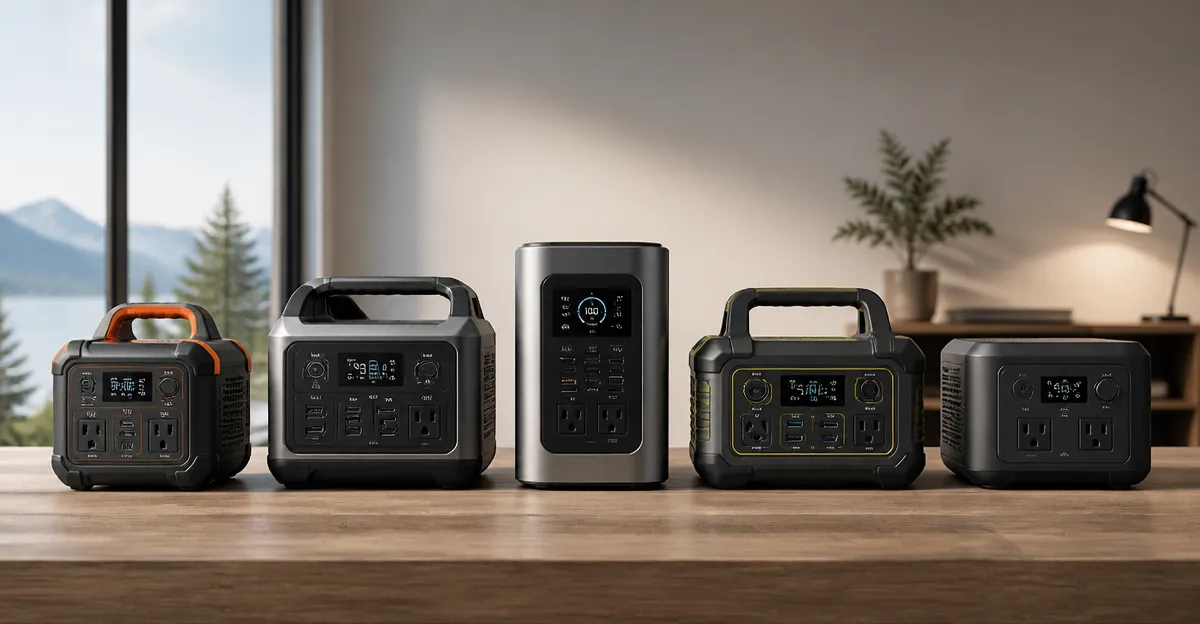
Introduction
The market for portable power stations has expanded rapidly as consumers seek reliable, clean energy for outdoor recreation, emergency backup, and remote work. This article compares five highly rated models that represent a range of capacities, charging technologies, and price points. By examining price, specifications, customer sentiment, and real‑world performance, readers can determine which unit best satisfies constraints such as limited space, high power demand, compatibility with solar panels, or a strict budget.
Individual Product Overviews
Jackery Explorer 1000 v2
Jackery Explorer 1000 v2 is a 1,024 Wh LiFePO4 power station that delivers 1,500 W continuous and 3,000 W surge power. Weighing 23.3 lb, it features two USB‑C ports, one USB‑A, a DC car port, and two pure‑sine‑wave AC outlets. The unit can be recharged from 0 % to 100 % in 50 minutes using the 10 ms UPS switchover and fast‑charging technology. The Jackery app allows users to select emergency, quiet, or efficiency charging modes.
EcoFlow DELTA 3 Max
EcoFlow DELTA 3 Max offers a 2,048 Wh LiFePO4 battery with 2,400 W continuous output and a 3,400 W X‑Boost peak. Its X‑Stream technology recharges the battery from 0 % to 80 % in just 1.13 hours. The unit provides ultra‑quiet operation, a sub‑10 ms transfer time for UPS protection, and a five‑year service warranty. The EcoFlow app supplies real‑time monitoring and smart scheduling.
Anker SOLIX C1000 Gen 2
Anker SOLIX C1000 Gen 2 delivers 1,024 Wh capacity and 2,000 W continuous (3,000 W peak) power through ten output ports. It recharges in 49 minutes via HyperFlash 1,600 W AC input and can be fully solar‑recharged in 1.8 hours using a 600 W panel. The unit is 14 % smaller and 11 % lighter than comparable models, and it includes a 10 ms UPS backup for critical devices.
BLUETTI Elite 100 V2
BLUETTI Elite 100 V2 provides a 1,024 Wh LiFePO4 battery with 1,800 W continuous (2,700 W surge) output. Its TurboBoost AC fast‑charging reaches 80 % in roughly 45 minutes, and the unit offers 10 ms UPS switchover, whisper‑quiet operation, and eleven mixed‑type ports. At 25 lb and a compact 17 L footprint, it targets users who need portability without sacrificing power.
EGO POWER+ Portable Power Station
EGO POWER+ Portable Power Station is a modular system that requires separate EGO ARC 56 V lithium batteries. With a 2,000 W continuous and 3,000 W peak inverter, it supplies four USB ports and three 120 V AC outlets. The unit is designed for indoor and outdoor use, features a pure‑sine‑wave output, and includes a bright LED display. Compatibility is limited to EGO batteries, which must be purchased separately.
Head-to-Head Comparison
Price and Value
The most affordable option is the BLUETTI Elite 100 V2 at $498.99, offering a comparable 1,024 Wh capacity to the Jackery and Anker units. The Jackery Explorer 1000 v2 is priced at $559.00, while the Anker SOLIX C1000 Gen 2 sits at $529.99, delivering faster AC charging. The high‑capacity EcoFlow DELTA 3 Max costs $878.99, reflecting its larger 2,048 Wh battery and 3,400 W boost capability. The EGO POWER+ unit itself is $478.00, but the total cost rises sharply when required EGO batteries are added, often exceeding $2,000 for a fully powered system.
Features and Specifications
All five units employ LiFePO4 chemistry, granting long cycle life and a ten‑year lifespan claim. The Jackery and BLUETTI models include built‑in solar compatibility limited to their own branded panels, whereas the Anker and EcoFlow units accept a broader range of solar inputs (up to 600 W for Anker, 1,600 W for EcoFlow). The EcoFlow DELTA 3 Max distinguishes itself with an X‑Boost 3,400 W peak and a five‑year service warranty. The Anker SOLIX C1000 Gen 2 provides ten output ports, the most of any model evaluated, making it ideal for multi‑device setups.
Customer Ratings and Feedback
Ratings are clustered between 4.3 and 4.7 stars. The Jackery Explorer 1000 v2 holds a 4.7 rating from 3,747 reviews, with users praising its app, rapid 50‑minute charge, and ability to run tools such as a 3 hp shop vac, while noting that very large appliances quickly deplete the battery. EcoFlow’s DELTA 3 Max also receives a 4.7 rating from 669 reviewers; customers highlight its fast X‑Stream charge and reliable UPS performance for home HVAC systems, though some note occasional app inaccuracies. Anker’s SOLIX C1000 Gen 2 has a 4.6 rating from 1,809 reviews; reviewers commend its ultra‑fast 49‑minute recharge and stable operation of CPAP machines and high‑performance laptops, but they mention a lack of a protective carrying case. BLUETTI’s Elite 100 V2 scores 4.5 from 1,851 reviewers, with praise for its quiet operation and versatile ports, alongside occasional concerns about warm DC outlets under load. The EGO POWER+ carries a 4.3 rating from 525 reviews; users appreciate its ability to run an air fryer and coffee maker, yet many criticize the mandatory use of proprietary batteries and the non‑functional Bluetooth app.
Performance and Reliability
Real‑world testing reported in reviews demonstrates that the Jackery can sustain a 3 hp shop vac for 15‑20 minutes before dropping from 95 % to 60 % charge, and it successfully powers heated blankets and a K‑cup machine at a youth soccer tournament. EcoFlow users have operated a 37 W gas furnace continuously for three days, noting a discharge rate of roughly 1 % per day when idle. Anker owners report that a 60 W AI coding laptop workload never reduced the battery below 99 % during solar operation, and a CPAP night consumes only 17 % of capacity. BLUETTI reviewers have run a small air conditioner for several hours and observed stable performance, though they caution that DC outlets may warm under higher loads. EGO users confirm that the unit can run an air fryer and a refrigerator for extended periods when paired with genuine EGO batteries, but surge overloads can trigger error messages.
Size, Power, Compatibility, and Price
In terms of weight, the Anker SOLIX C1000 Gen 2 is the lightest, at roughly 14 % smaller and 11 % lighter than comparable models, while the BLUETTI Elite 100 V2 weighs 25 lb, and the Jackery is 23.3 lb. The EcoFlow DELTA 3 Max is the heaviest due to its larger battery, yet its 2,048 Wh capacity supplies the highest continuous power. Compatibility varies: Jackery and BLUETTI recommend only their own solar panels, Anker and EcoFlow accept a wide range of panels, and EGO is limited to proprietary ARC batteries, restricting flexibility for users who already own solar accessories.
Comparison Table
| Product | Capacity (Wh) | Continuous Power (W) | Peak Power (W) | Fast Charge Time (0‑80%) | Weight (lb) | Price (USD) | Rating |
|---|---|---|---|---|---|---|---|
| Jackery Explorer 1000 v2 | 1,024 | 1,500 | 3,000 | 50 min (full) | 23.3 | 559.00 | 4.7 (3,747) |
| EcoFlow DELTA 3 Max | 2,048 | 2,400 | 3,400 | 1.13 hr (0‑80%) | ~30 | 878.99 | 4.7 (669) |
| Anker SOLIX C1000 Gen 2 | 1,024 | 2,000 | 3,000 | 49 min (full) | ~22 | 529.99 | 4.6 (1,809) |
| BLUETTI Elite 100 V2 | 1,024 | 1,800 | 2,700 | 45 min (80%) | 25 | 498.99 | 4.5 (1,851) |
| EGO POWER+ Portable Power Station | — (battery sold separately) | 2,000 | 3,000 | — (depends on battery) | — (over 100 lb with batteries) | 478.00 (unit only) | 4.3 (525) |
Pros & Cons
Jackery Explorer 1000 v2
- Pros: Fast 50‑minute full charge, robust 3,000 W surge, versatile port selection, high user rating, durable LiFePO4 battery lasting over 4,000 cycles.
- Cons: Solar compatibility limited to Jackery panels, heavy for backpacking, some users report the app requiring occasional resets.
EcoFlow DELTA 3 Max
- Pros: Largest capacity (2,048 Wh), 3,400 W X‑Boost output, ultra‑fast 0‑80 % charge in 1.13 hr, five‑year service warranty, quiet operation.
- Cons: Highest price, heavier unit, occasional app display inaccuracies reported.
Anker SOLIX C1000 Gen 2
- Pros: Ultra‑fast 49‑minute AC charge, ten output ports, compact and lightweight design, reliable under heavy laptop loads, strong solar performance (1.8 hr with 600 W).
- Cons: No protective carrying case included, some users note a slight power loss when left unplugged for extended periods.
BLUETTI Elite 100 V2
- Pros: Competitive price, 45‑minute rapid charge, whisper‑quiet operation, 11 ports, 10 ms UPS backup, 10‑year LiFePO4 lifespan.
- Cons: Pre‑order status (available December 2026), DC outlets may warm under high load, occasional fan error messages during solar charging.
EGO POWER+ Portable Power Station
- Pros: High surge power (3,000 W), pure sine‑wave output safe for sensitive electronics, robust steel handles, compatible with all EGO ARC batteries.
- Cons: Batteries sold separately dramatically increase total cost, Bluetooth/app functionality broken for many users, limited to proprietary batteries, heavy when fully loaded.
Recommendations
If space is the primary constraint, the Anker SOLIX C1000 Gen 2 offers the smallest footprint while still providing 2,000 W continuous power and rapid charging. For users who require the greatest amount of energy for extended outages, the EcoFlow DELTA 3 Max delivers double the capacity of the other models and the highest peak power, making it suitable for running multiple high‑draw appliances simultaneously. When compatibility with existing Jackery solar panels is essential, the Jackery Explorer 1000 v2 provides a balanced blend of power, price, and app control. Budget‑focused buyers who still desire reliable backup will find the BLUETTI Elite 100 V2 to be the most cost‑effective solution, especially once it becomes available. Finally, professionals already invested in the EGO ecosystem may prefer the EGO POWER+ Portable Power Station, provided they are prepared to purchase the required batteries.
FAQ
- Can these power stations be used as UPS for sensitive electronics? All five models include a sub‑10 ms UPS switchover, ensuring that computers, medical devices, and routers experience no interruption during a grid outage.
- How long does it take to fully charge each unit from a wall outlet? Jackery requires 50 minutes for a full charge, EcoFlow needs about 1.13 hours to reach 80 %, Anker completes a full charge in 49 minutes, BLUETTI reaches 80 % in 45 minutes, and EGO’s charge time depends on the capacity of the attached ARC batteries.
- Are these units compatible with any solar panel? Anker and EcoFlow accept a wide range of solar panels (up to 600 W and 1,600 W respectively). Jackery and BLUETTI recommend only their branded panels, while EGO requires no solar input because it relies on battery packs.
- What is the expected lifespan of the batteries? All models use LiFePO4 chemistry that typically endures over 4,000 charge cycles while retaining at least 70‑80 % of original capacity, translating to an estimated ten‑year service life.
- Which model provides the most ports for simultaneous device charging? The Anker SOLIX C1000 Gen 2 offers ten output ports, surpassing the other units, which range from four to eleven mixed‑type ports.
- Is there an app that can monitor power usage? Jackery, EcoFlow, Anker, and BLUETTI all provide dedicated mobile apps for real‑time monitoring and mode selection. The EGO app currently suffers from functional issues reported by users.
- Do any of these units require additional accessories to achieve full functionality? Jackery and BLUETTI require their own solar panels for optimal solar charging. The EGO system requires separate ARC batteries, and the EcoFlow and Anker units benefit from optional high‑output solar panels for the fastest recharge rates.
Conclusion
Each portable power station examined excels in specific scenarios. The Anker SOLIX C1000 Gen 2 stands out for compactness and rapid charging, the EcoFlow DELTA 3 Max leads in capacity and peak power, the Jackery Explorer 1000 v2 offers a well‑rounded feature set with an intuitive app, the BLUETTI Elite 100 V2 provides the best value for budget‑conscious users, and the EGO POWER+ Portable Power Station is ideal for those already invested in the EGO battery ecosystem. Prospective buyers should match their primary requirement—whether it be space, power, compatibility, or cost—with the strengths highlighted above to select the most appropriate solution.
Frequently Asked Questions
What is the battery capacity of the Jackery Explorer 1000 v2?
It has a 1,024 Wh LiFePO4 battery.
How quickly can the Jackery Explorer 1000 v2 reach a full charge?
It can charge from 0 % to 100 % in roughly 50 minutes using fast‑charging technology.
What are the continuous and surge power ratings of the Jackery Explorer 1000 v2?
It delivers 1,500 W continuous and up to 3,000 W surge power.
Which output ports does the Jackery Explorer 1000 v2 provide?
It offers two USB‑C ports, one USB‑A port, a DC car port, and two pure‑sine‑wave AC outlets.
Can the Jackery Explorer 1000 v2 be recharged with solar panels?
Yes, it is compatible with solar charging for off‑grid use.