Introduction
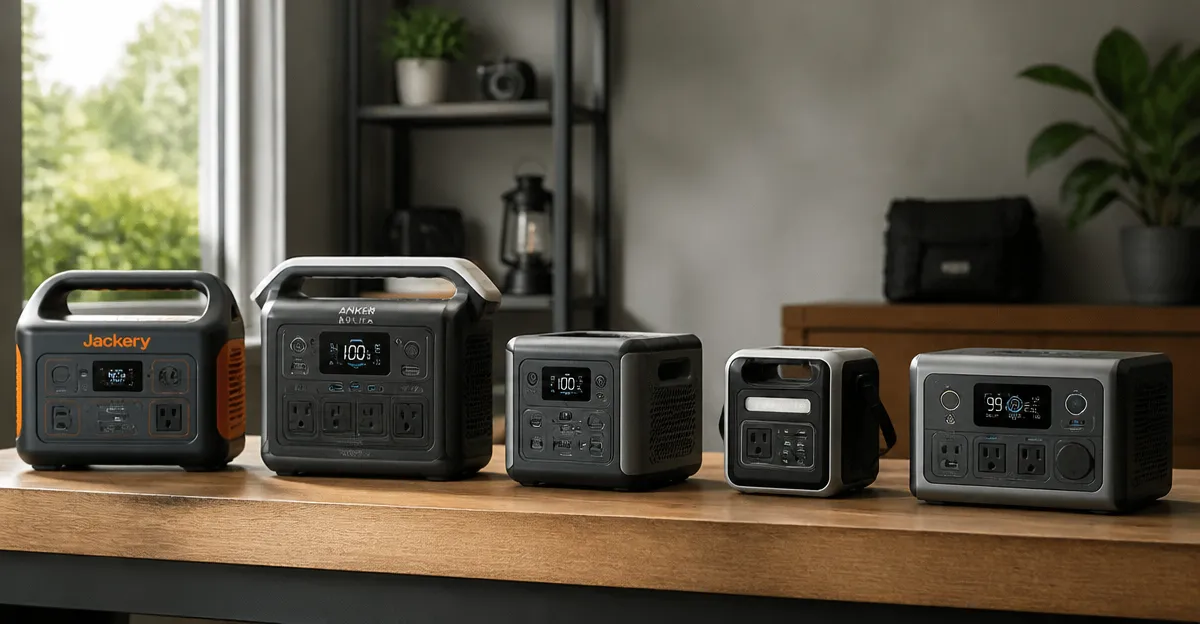
Portable power stations have become essential tools for outdoor enthusiasts, remote workers, and homeowners who require reliable backup electricity. This article compares five highly rated models that appear frequently on Amazon: Jackery Explorer 1000 v2, Anker SOLIX S2000, Anker SOLIX C300, ALLWEI 300W, and BLUETTI Elite 30 V2. The comparison focuses on price, specifications, user sentiment, and real‑world performance to help readers select the unit that best matches their constraints.
Individual Product Overviews
Jackery Explorer 1000 v2
Jackery offers a 1,070 Wh lithium‑iron‑phosphate (LFP) battery housed in a 23.8‑lb case. It delivers 1,500 W continuous AC power with a 3,000 W surge capability. The unit supports rapid one‑hour emergency charging via the Jackery app and includes two USB‑C, one USB‑A, a DC car port, and three pure sine wave AC outlets. Customer reviews praise its versatility for camping and tool use, noting that a 3 hp shop vac reduces the charge from 95 % to 60 % in roughly 15 minutes. One reviewer stated, "The app is super easy to use, the battery life seems great, and you can run most power tools off it too." The price is $499.00 and the rating stands at 4.7/5 from 3,700 reviews.
Anker SOLIX S2000
Anker’s flagship model provides 2,010 Wh of LFP capacity in a 35.7‑lb chassis. It supplies 1,500 W continuous and 3,000 W peak output, and can accept up to 400 W solar input. The station includes eight outlets (five AC, two USB‑C, one USB‑A) and supports six recharging methods, including AC, solar, generator, car, and alternator. Reviewers highlight its efficiency, noting a 35‑hour refrigerator backup and a standby draw of only 3 W in UPS mode. One user wrote, "The S2000 will power a 200 W load for around NINE HOURS," and another praised the quiet operation and robust app control. The price is $649.98 with a 4.7/5 rating from 396 reviews.
Anker SOLIX C300
The C300 is a compact 288 Wh, 300 W LFP power station weighing 8 lb. It features two 140 W USB‑C ports, an additional 100 W USB‑C, a 15 W USB‑C, two USB‑A ports, and a 120 W car socket. Solar charging is supported via a 100 W panel, and the unit can reach 80 % charge in one hour using dual PD 3.1 ports. Customers appreciate its rugged yet lightweight design, with one review stating, "It easily handled charging my phone, tablet, Bluetooth speaker, and even ran a small camp fridge overnight." The rating is 4.5/5 from 1,770 reviews, and the price is $199.99.
ALLWEI 300W
ALLWEI delivers 256 Wh of LFP capacity in a 6.4‑lb, 9.25×5×6.81 in package. It provides 300 W continuous and 600 W surge power, with six output ports including a 60 W USB‑C PD, 18 W USB‑A, and two DC5521 ports. The unit can be recharged via AC, car, or solar (up to 100 W) and supports dual‑charging for faster top‑up. Reviewers commend its thin profile and clear display, noting, "The flashlight on the end of the device is perfectly placed" and that it can run a large Bluetooth speaker for several hours without issue. The price is $159.00 and the rating is 4.4/5 from 2,455 reviews.
BLUETTI Elite 30 V2
BLUETTI’s Elite 30 V2 offers 288 Wh of capacity in a 9.4‑lb package. It supplies 600 W continuous power and can boost to 1,500 W in Power Lifting Mode. The station features fast wall charging (380 W) that reaches 80 % in 45 minutes and includes an 8‑outlet layout with AC, USB‑C, and USB‑A ports. Users highlight its low standby draw (4.5 W) and UPS capability, with one reviewer stating, "It gave me 2.4 hrs on a 150 W load compared with the old UPS that only gave an hour." The price is $289.99 and the rating is 4.4/5 from 1,222 reviews.
Head‑to‑Head Comparison
Price and Value
When evaluating cost, the ALLWEI 300W emerges as the most affordable at $159.00, offering a respectable 256 Wh capacity for light‑to‑moderate loads. The BLUETTI Elite 30 V2 follows at $289.99, providing a similar 288 Wh but with higher continuous power (600 W) and rapid charging. The Anker SOLIX C300 is priced at $199.99, delivering the same 288 Wh but with a lower 300 W output, making it a middle‑ground option for campers who prioritize portability. The Jackery Explorer 1000 v2 costs $499.00, reflecting its larger 1,070 Wh battery and 1,500 W output. Finally, the Anker SOLIX S2000 commands the highest price at $649.98, justified by its 2,010 Wh capacity and 1,500 W continuous power.
Features and Specifications
All five stations employ LFP chemistry, which ensures long cycle life. Jackery and Anker S2000 both deliver 1,500 W continuous power, while the BLUETTI Elite 30 V2 offers 600 W with a 1,500 W boost mode. The SOLIX C300 and ALLWEI 300W are limited to 300 W and 300 W respectively, suitable for low‑draw devices such as phones, laptops, and small fans. In terms of recharging versatility, the SOLIX S2000 supports six methods, the most extensive set, whereas Jackery relies on its proprietary solar panels and AC input. The ALLWEI and BLUETTI units both provide dual‑charging (AC + solar) with MPPT controllers for efficient solar capture.
Customer Ratings and Feedback
Jackery and Anker S2000 share the highest rating of 4.7/5, reflecting strong satisfaction across thousands of users. Reviewers of Jackery note its "super easy" app and reliable performance with power tools, yet some mention the weight (23.8 lb) as a drawback for hiking. The SOLIX S2000 is praised for its efficiency and low standby draw, with a user stating, "It only draws 3 watts in UPS mode." The C300 receives commendation for its compactness and solar compatibility, though a few users criticize the lack of an included wall charger. ALLWEI’s 4.4/5 rating is bolstered by comments on its thin design and accurate battery‑time display, while BLUETTI’s 4.4/5 reviewers appreciate its rapid wall charging and UPS functionality.
Performance and Reliability
Long‑term durability is highlighted across the board. Jackery claims a 10‑year lifespan with over 4,000 charge cycles, a claim echoed by a reviewer who observed "over 70 % capacity after many cycles." Anker S2000 advertises a 15‑year lifespan and 10,000 cycles, and users confirm the unit can sustain a 200 W load for nine hours. The C300’s LiFePO₄ cells promise a 3‑year warranty and 3,000‑cycle life, with field tests showing successful operation of a CPAP machine overnight. ALLWEI emphasizes a 10‑year performance target with 3,000 cycles, and owners report reliable operation of multiple fridges when three units are networked. BLUETTI’s UltraCell technology reduces power consumption by 50 %, and reviewers note the unit’s ability to keep networking gear alive during storms.
Size, Power, Compatibility, and Price
Size and weight are decisive for backpacking. The C300 (8 lb) and BLUETTI Elite 30 V2 (9.4 lb) are the lightest, while the SOLIX S2000 (35.7 lb) and Jackery (23.8 lb) suit vehicle‑based camping. In terms of raw power, the Jackery and SOLIX S2000 dominate with 1,500 W continuous output, making them suitable for heavy tools or small appliances. Compatibility varies: Jackery only accepts its own solar panels, whereas the SOLIX S2000, ALLWEI, and BLUETTI accept standard 100 W solar panels. The SOLIX C300 provides versatile USB‑C PD ports for modern laptops, a feature absent on the ALLWEI unit.
Comparison Table
| Product | Capacity (Wh) | Continuous Power (W) | Peak Power (W) | Weight (lb) | Price (USD) | Rating |
|---|---|---|---|---|---|---|
| Jackery Explorer 1000 v2 | 1,070 | 1,500 | 3,000 | 23.8 | 499.00 | 4.7/5 (3,700) |
| Anker SOLIX S2000 | 2,010 | 1,500 | 3,000 | 35.7 | 649.98 | 4.7/5 (396) |
| Anker SOLIX C300 | 288 | 300 | 300 | 8 | 199.99 | 4.5/5 (1,770) |
| ALLWEI 300W | 256 | 300 | 600 | 6.4 | 159.00 | 4.4/5 (2,455) |
| BLUETTI Elite 30 V2 | 288 | 600 | 1,500 | 9.4 | 289.99 | 4.4/5 (1,222) |
Pros & Cons
Jackery Explorer 1000 v2
- Pros: High capacity (1,070 Wh), 1,500 W continuous power, fast one‑hour emergency charging, robust app control.
- Cons: Heavier than most competitors, solar panel compatibility limited to Jackery panels, price higher than similar capacity units.
Anker SOLIX S2000
- Pros: Largest capacity (2,010 Wh), 10‑year lifespan, six recharging options, low 3 W UPS standby draw.
- Cons: Bulky weight (35.7 lb), premium price, no 12 V DC barrel port.
Anker SOLIX C300
- Pros: Compact and lightweight (8 lb), fast 80 % charge in one hour, multiple high‑power USB‑C ports, LiFePO₄ durability.
- Cons: No included wall charger, limited to 300 W continuous output, solar panel compatibility restricted to specific Anker panels.
ALLWEI 300W
- Pros: Very light (6.4 lb), thin form factor, clear display with time‑remaining estimate, dual‑charging capability.
- Cons: Lower capacity (256 Wh), peak power only 600 W, fewer AC outlets (single AC socket).
BLUETTI Elite 30 V2
- Pros: High 600 W continuous power in a small package, ultra‑fast 0‑80 % wall charge in 45 min, UPS switch‑over under 10 ms.
- Cons: Capacity limited to 288 Wh, no dedicated solar MPPT controller, price slightly above similarly sized competitors.
Recommendations
Best for limited storage space: The Anker SOLIX C300 weighs only 8 lb and fits easily into a backpack, making it ideal for hikers who need modest power for phones, a small fridge, or a CPAP machine.
Best for maximum power output: The Anker SOLIX S2000 provides 2,010 Wh and 1,500 W continuous power, suitable for workshops, RVs, or extended off‑grid living.
Best budget option: The ALLWEI 300W offers a respectable 256 Wh at $159, perfect for emergency backup of phones, laptops, and small appliances.
Best balanced mid‑range choice: The BLUETTI Elite 30 V2 combines 600 W continuous power, rapid wall charging, and UPS capability at a moderate price.
Best for heavy‑duty tool use: The Jackery Explorer 1000 v2 balances high capacity with a 1,500 W inverter, making it suitable for job sites and larger camping appliances.
Frequently Asked Questions
- Can these stations be used as a UPS for a home office? Yes. Both the Jackery Explorer 1000 v2 and BLUETTI Elite 30 V2 advertise sub‑10 ms UPS switch‑over, protecting computers and networking gear during outages.
- How long does it take to fully charge each unit from AC power? Jackery claims a one‑hour emergency boost (default 1.7 h), the SOLIX S2000 reaches 0‑80 % in about 1.5 h, the C300 achieves 80 % in one hour, ALLWEI needs 3.5‑4 h, and BLUETTI Elite 30 V2 reaches 80 % in 45 min with its 380 W wall charger.
- Are the solar inputs interchangeable between brands? The Jackery Explorer only accepts Jackery panels, while the SOLIX S2000, ALLWEI, and BLUETTI accept standard 100 W solar panels. The C300 works with Anker 100 W panels but is not compatible with lower‑voltage USB‑C solar panels.
- Which model provides the longest refrigerator backup? According to user reports, the SOLIX S2000 can keep a typical fridge running for up to 35 hours, whereas the Jackery Explorer 1000 v2 ran a 12‑quart DC fridge for three days, dropping from 100 % to 43 %.
- Do any of these units have built‑in lighting? Both Jackery Explorer 1000 v2 and ALLWEI 300W include LED lights; the ALLWEI model offers three brightness levels and an SOS mode, while Jackery provides a single LED for emergency illumination.
- Is there a warranty for these power stations? ALLWEI offers a five‑year warranty, Jackery provides a ten‑year lifespan claim (typically a 2‑year warranty), Anker supplies a standard one‑year warranty with optional extended protection, and BLUETTI includes a two‑year warranty.
- Can I expand the battery capacity? The Jackery Explorer 1000 v2 and SOLIX S2000 support optional external battery packs, though they are expensive. The other models do not currently offer official expansion modules.
Conclusion
Choosing the right portable power station depends on the balance between capacity, power output, weight, and budget. For users who need the most energy storage and can accommodate a larger unit, the Anker SOLIX S2000 stands out as the clear leader. For those constrained by space or weight, the Anker SOLIX C300 or BLUETTI Elite 30 V2 deliver solid performance in compact packages. Budget‑focused buyers will find the ALLWEI 300W to be a reliable entry point, while the Jackery Explorer 1000 v2 offers a middle ground with strong app integration and a respectable 1,070 Wh capacity. Ultimately, the decision should align with the user’s primary use case—whether that is heavy‑duty tool operation, long‑duration off‑grid living, or lightweight camping.