Introduction
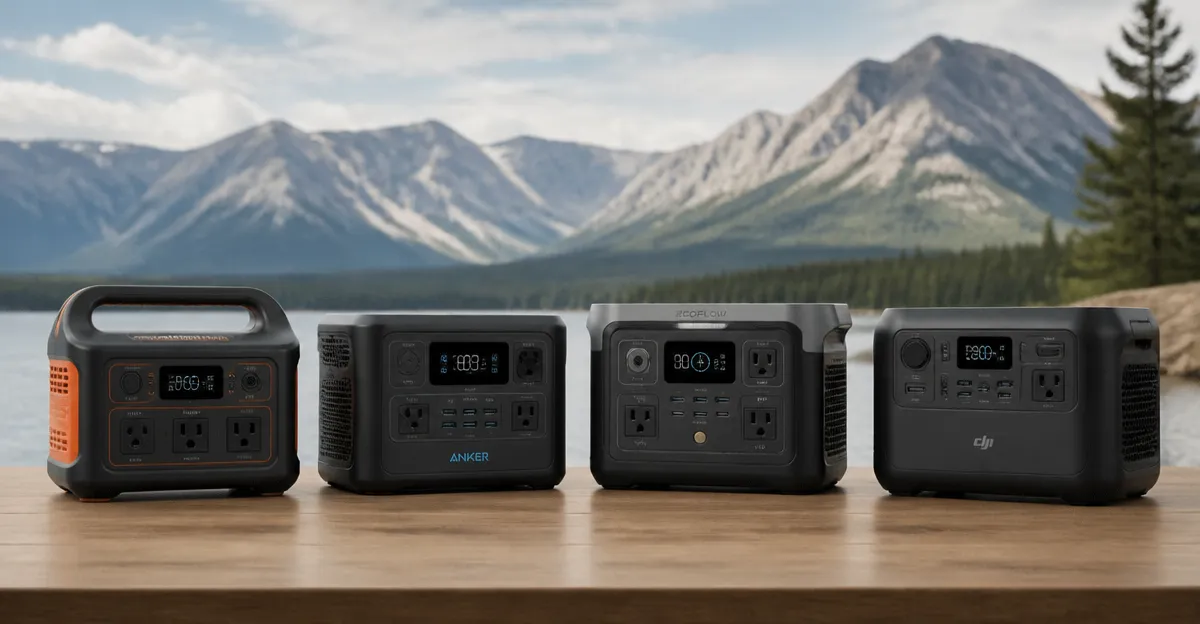
Portable power stations have become essential tools for outdoor enthusiasts, remote workers, and emergency preparedness. Comparing the leading models helps consumers identify the unit that delivers the optimal balance of price, capacity, and versatility. This article evaluates five popular devices: Jackery Explorer 1000 v2, Anker SOLIX C1000 Gen 2, EcoFlow DELTA 3 Max, DJI Power 2000, and Jackery Solar Generator 300. The analysis focuses on price, specifications, customer feedback, and real‑world performance.
Individual Product Overviews
Jackery Explorer 1000 v2
The Explorer 1000 v2 provides 1,070 Wh of energy, a continuous 1,500 W AC output, and a 3,000 W surge capability. Weighing 23.8 lbs, it features a foldable handle for easy transport and includes two USB‑C ports, one USB‑A port, a DC car port, and three pure sine wave AC outlets. Fast charging is achieved in one hour via the Jackery app’s emergency mode, while the default 1.7‑hour charge protects battery health. The unit uses a lithium‑iron‑phosphate (LFP) battery rated for over 4,000 cycles, maintaining more than 70% capacity after a decade of use. It holds a 4.7/5.0 rating from 3,714 reviews and is priced at $499.00.
Anker SOLIX C1000 Gen 2
The SOLIX C1000 Gen 2 delivers 1,024 Wh of capacity and a 2,000 W continuous output with a 3,000 W surge peak. At 14% smaller size and 11% lighter weight than comparable models, it remains highly portable. Its HyperFlash technology enables a 1‑hour 49‑minute full recharge at 1,600 W, while solar input of 600 W reaches 80% in 1.8 hours. The device includes ten ports, a 10 ms UPS switch, and an app‑controlled TOU mode for energy‑cost management. After 4,000 cycles, the battery retains at least 80% capacity, supporting a ten‑year lifespan claim. Customer sentiment is reflected in a 4.7/5.0 rating from 1,764 reviews, and the price is $499.99.
EcoFlow DELTA 3 Max
The DELTA 3 Max boasts a 2,048 Wh LFP battery and 2,400 W continuous output, expandable to 3,400 W in X‑Boost mode. Ultra‑fast X‑Stream charging reaches 80% in 1.13 hours, dramatically reducing downtime. The unit supplies a sub‑10 ms transfer time and operates at low noise levels, making it suitable for home backup and medical equipment. Its robust construction promises ten years of daily use, with a five‑year service warranty. The product carries a 4.7/5.0 rating from 650 reviews and is listed at $899.00.
DJI Power 2000
The Power 2000 provides 2,048 Wh of LFP storage and can power 99% of household appliances. It reaches 80% charge in 55 minutes, the fastest among the group. Noise output drops to 30 dB, and a 10 ms UPS switch protects sensitive devices. The station includes 15 ports, dual full SDC ports, and supports expansion up to 22.5 kWh with optional batteries. Safety features such as a smart BMS and flame‑retardant housing are highlighted. It holds a 4.4/5.0 rating from 809 reviews and costs $749.99.
Jackery Solar Generator 300
The Explorer 300 is an ultra‑lightweight 292 Wh unit weighing only 7.5 lbs, with a 300 W rated AC output (600 W surge). It offers two AC outlets, a 100 W USB‑C PD port, two USB‑A ports, and a 120 W car port, enabling simultaneous charging of up to six devices. Fast solar charging reaches 80% in 2.8 hours with a 100 W panel, and the LFP battery endures more than 4,000 cycles before dropping to 70% capacity. Customer feedback shows a 4.4/5.0 rating from 232 reviews, and the price is $339.00.
Head-to-Head Comparison
Price and Value
Price points range from $339.00 for the Jackery Solar Generator 300 to $899.00 for the EcoFlow DELTA 3 Max. The Jackery Explorer 1000 v2 and Anker SOLIX C1000 Gen 2 are priced similarly around $500, offering mid‑range capacity and fast charging. The DJI Power 2000 sits at $749.99, providing a blend of high capacity and rapid recharge. When evaluating value, the lower‑priced Explorer 300 delivers excellent portability but limited energy storage, while the DELTA 3 Max commands a premium for its X‑Boost power and ultra‑fast charging.
Features and Specifications
All five models employ lithium‑iron‑phosphate chemistry, which enhances cycle life and safety. The Explorer 1000 v2 offers three pure sine wave AC outlets and a 1,500 W continuous output, whereas the SOLIX C1000 Gen 2 supplies the highest continuous power at 2,000 W and ten versatile ports. The DELTA 3 Max distinguishes itself with 3,400 W X‑Boost output and the fastest 0‑80% charge time of 1.13 hours. DJI’s Power 2000 emphasizes rapid 55‑minute 80% charge and ultra‑quiet operation at 30 dB. The Explorer 300 focuses on lightweight design and a modest 300 W output, ideal for short trips.
Customer Ratings and Feedback
Four of the units share a 4.7/5.0 rating, indicating strong overall satisfaction. The DJI Power 2000’s 4.4/5.0 rating reflects slightly more mixed experiences, often related to its expansion‑battery requirement. Review counts vary, with the Jackery Explorer 1000 v2 receiving the most feedback (3,714 reviews), suggesting a large user base and extensive real‑world testing. The SOLIX C1000 Gen 2, DELTA 3 Max, and Explorer 300 have fewer reviews but maintain high scores, reinforcing confidence in their performance.
Performance and Reliability
Reliability is anchored in cycle life; the Explorer 1000 v2 guarantees over 4,000 cycles with 70% capacity retention after ten years. Anker’s claim of 80% capacity after 4,000 cycles and EcoFlow’s ten‑year design further underscore durability. DJI highlights a smart BMS and flame‑retardant housing for harsh environments, while the Explorer 300’s 4,000‑cycle rating aligns with the other LFP models. In terms of surge capability, the Explorer 1000 v2 (3,000 W) and SOLIX C1000 Gen 2 (3,000 W) match the DELTA 3 Max’s 3,400 W X‑Boost, providing ample headroom for high‑draw appliances.
Size, Power, Compatibility, and Price
Weight ranges from 7.5 lb (Explorer 300) to 23.8 lb (Explorer 1000 v2). The SOLIX C1000 Gen 2 is marginally lighter than the Explorer 1000 v2, yet both exceed the Explorer 300’s portability. Compatibility varies; the Explorer 1000 v2 works exclusively with Jackery solar panels, while the SOLIX C1000 Gen 2 accepts up to 600 W solar input via a separate adapter. The DELTA 3 Max and DJI Power 2000 support broader solar options but require additional accessories for optimal charging. Price correlates with capacity: higher‑capacity units command higher costs, but the SOLIX C1000 Gen 2 delivers a compelling power‑to‑price ratio.
Comparison Table
| Product | Capacity (Wh) | Continuous Output (W) | Surge Peak (W) | Weight (lb) | Price (USD) | Rating |
|---|---|---|---|---|---|---|
| Jackery Explorer 1000 v2 | 1,070 | 1,500 | 3,000 | 23.8 | 499.00 | 4.7 (3,714) |
| Anker SOLIX C1000 Gen 2 | 1,024 | 2,000 | 3,000 | ~20 | 499.99 | 4.7 (1,764) |
| EcoFlow DELTA 3 Max | 2,048 | 2,400 | 3,400 (X‑Boost) | ~27 | 899.00 | 4.7 (650) |
| DJI Power 2000 | 2,048 | 2,000 | 2,500 | ~25 | 749.99 | 4.4 (809) |
| Jackery Solar Generator 300 | 292 | 300 | 600 | 7.5 | 339.00 | 4.4 (232) |
Pros & Cons
Jackery Explorer 1000 v2
- Pros: High capacity (1,070 Wh), 3,000 W surge, fast 1‑hour emergency charging, robust LFP lifespan.
- Cons: Heavier than competitors, solar compatibility limited to Jackery panels.
Anker SOLIX C1000 Gen 2
- Pros: Highest continuous output (2,000 W), ten versatile ports, 1.8 hr solar recharge, 10 ms UPS switch.
- Cons: Slightly larger footprint, premium price for similar capacity.
EcoFlow DELTA 3 Max
- Pros: Largest capacity (2,048 Wh), X‑Boost 3,400 W, fastest 0‑80% charge (1.13 hr), low noise.
- Cons: Highest price, heavier unit.
DJI Power 2000
- Pros: Rapid 55‑minute 80% charge, ultra‑quiet operation, 15 ports, expandable storage.
- Cons: Lower rating, expansion batteries sold separately increase total cost.
Jackery Solar Generator 300
- Pros: Ultra‑lightweight, lowest price, simple interface, fast solar charge with 100 W panel.
- Cons: Limited capacity (292 Wh), lower continuous output, fewer ports.
Recommendations
If space is the primary constraint, the Jackery Solar Generator 300 offers the smallest footprint and lightest weight, making it ideal for backpacking or day trips. For users requiring the greatest power output for RVs or workshop tools, the EcoFlow DELTA 3 Max provides unmatched X‑Boost capability and massive capacity. Budget‑conscious buyers who still need solid performance should consider the Jackery Explorer 1000 v2, which balances cost and capacity. Those prioritizing rapid recharge and multiple device connectivity will benefit from the Anker SOLIX C1000 Gen 2. Finally, the DJI Power 2000 is suited for users who value ultra‑quiet operation and future expansion potential.
FAQ
- Can these power stations be used with any solar panel? The Jackery Explorer 1000 v2 is compatible only with Jackery panels, while the SOLIX C1000 Gen 2 and DELTA 3 Max accept third‑party panels up to their specified wattage. DJI requires a separate adapter for solar input.
- How long does it take to fully charge each unit from a wall outlet? Explorer 1000 v2 charges in 1 hour using emergency mode, otherwise 1.7 hours; SOLIX C1000 Gen 2 reaches full charge in 1 hour 49 minutes; DELTA 3 Max reaches 80% in 1.13 hours; DJI Power 2000 reaches 80% in 55 minutes; Explorer 300 reaches 80% in approximately 2.8 hours with a 100 W panel.
- Which model offers the longest battery lifespan? All models use LFP chemistry with cycle ratings of 4,000+ cycles. Jackery and DJI guarantee over ten years, Anker promises ten years, and EcoFlow advertises ten years with a five‑year service plan.
- Are these units safe for indoor use? Yes. Each device includes built-in BMS, flame‑retardant housing, and pure sine wave AC output, making them safe for indoor environments when used according to the manufacturer’s guidelines.
- What is the UPS switch time and why does it matter? UPS switch time is the delay before the power station supplies electricity during an outage. The SOLIX C1000 Gen 2, DELTA 3 Max, and DJI Power 2000 all achieve sub‑10 ms switch times, ensuring uninterrupted operation of sensitive equipment such as computers and medical devices.
- Can I expand the power capacity of these stations? DJI Power 2000 supports expansion up to 22.5 kWh with optional batteries. The other models do not offer official expansion modules, though additional solar panels can increase recharging speed.
- Which unit provides the quietest operation? DJI Power 2000 operates as low as 30 dB, while the DELTA 3 Max is also noted for ultra‑quiet performance. Both are suitable for nighttime use in RVs or tents.
Conclusion
Each portable power station reviewed excels in specific scenarios. The Jackery Explorer 1000 v2 delivers a solid blend of capacity, price, and durability for general outdoor use. Anker’s SOLIX C1000 Gen 2 stands out with the highest continuous output and extensive port selection, making it a versatile choice for remote work and emergency backup. EcoFlow’s DELTA 3 Max commands a premium for its massive capacity, X‑Boost power, and industry‑leading fast charge. DJI’s Power 2000 offers rapid recharge and ultra‑quiet operation, appealing to users who prioritize speed and low noise. Finally, the Jackery Solar Generator 300 provides an ultra‑lightweight, budget‑friendly option for short excursions. Prospective buyers should align their selection with the primary constraint—whether space, power demand, compatibility, or budget—to achieve optimal satisfaction.
Frequently Asked Questions
Which portable power station has the highest watt‑hour capacity among the models compared?
The DJI Power 2000 leads with a 2,060 Wh capacity, surpassing the other units.
How does the continuous AC output of the Jackery Explorer 1000 v2 compare to the Anker SOLIX C1000 Gen 2?
Jackery provides 1,500 W continuous AC, while Anker offers 1,200 W continuous output.
Is the EcoFlow DELTA 3 Max suitable for high‑surge appliances?
Yes, it supports up to 3,000 W surge power, allowing brief use of high‑draw devices.
What is the main advantage of the Jackery Solar Generator 300 for off‑grid use?
Its integrated solar panel enables recharging without a wall outlet, ideal for camping or emergencies.
Which of the reviewed power stations offers the best price‑to‑capacity ratio?
The Jackery Explorer 1000 v2 generally provides the most favorable price per watt‑hour among the five models.